Taking It All Apart: Principles of Network Modularity
Office of Plans and Policy
Federal Communications Commission
Washington, D.C. 20554
January 1992
Presented at the Conference on
Private Networks and Public Objectives
Columbia Institute for Tele-Information
December 6, 1991
I. Introduction
When the Federal Communications Commission (FCC) acted to remove the regulatory barriers to entry for the long distance and customer premises equipment (CPE) markets, it sought to increase the number of suppliers in these markets so that consumers coul d realize the benefits of competition. In moving to deregulate these markets, the FCC reasoned that there were no inherent features to the structure of these markets, or adverse impacts on other policy objectives, which should preclude competition. Subseq uently, consumers have arguably enjoyed lower prices and more innovative service offerings in these markets. The long distance and CPE markets serve as notable examples of the general policy direction taken by the FCC in the 1980s to reduce the traditiona l telephone monopoly into a set of competitive markets for the purpose of bringing the benefits of competition to consumers of telecommunications services. But while these two components of the monopoly have been stripped away in this process, the barrier s to competition with the local access network--the portion of the public network which extends between the interexchange carrier's network and the end user--still remains in pre-divestiture form.
It now appears to be an opportune moment to reexamine the extent to which competition can be brought to the local access switching and transport markets. The proliferation of private network alternatives improves the prospects for facilities-based comp etition in the transport of communications services. These alternatives include cable television networks, wireless telephone networks, local area networks (LANs) and metropolitan area networks (MANs). Local exchange carriers (LECs) have indicated that th ey foresee their network evolving into a multimedia platform capable of delivering a rich variety of text, imaging, and messaging services. Many take this multiple service scenario a step further and imagine an "open" network platform--a network with well defined interfaces accessible to all--which would allow an unlimited number of entrepreneurs a means to offer services in competition with one another limited only by their imagination and the fundamental capabilities of the underlying network facilities .
In this context, the policy question of interest is the extent to which the local access network might be decomposed to stimulate competition in markets for local switching and transport. Could competition satisfactorily emerge by simply removing the r egulatory barriers to entry or is some form of open access requirements needed to introduce competition into the market? If there are elements of a natural monopoly in the local exchange network, then policies which promote open access to these centralize d network resources can be instrumental in promoting a competitive market in spite of its monopolistic nature. Indeed, the FCC has already begun to consider what open access requirements are necessary in the local exchange network to insure open and equal access to the network in its Open Network Architecture (ONA) policy. 2 Likewise, the Europeans also have their own initiative, called Open Network Provision (ONP), for opening up access to their public n etworks.
The cornerstone of the ONA policy is the notion of unbundling network components to create open access to network resources. 3 Formally, network unbundling refers to the process of breaking the networ k into separate functional elements, or building blocks. Independent service providers could select only those unbundled components needed for their own service applications since the network operator cannot tie the availability of one element to subscrip tion with another. If the price of the unbundled component exceeds what it would cost the service provider to provide this functionality on its own, the service provider has the flexibility to substitute its own private resources for the unbundled compone nt.
Clearly, one could continue almost ad infinitum in this unbundling process, and one of the issues raised by this approach is the appropriate limit to this process. For example, network components can be classified into either logical or physical element categories. A logical element is a software defined network feature or capability, such as the number translation performed in a switch to establish a call; a physical element is the physical resource employed in the transmission or switching of the service. 4 Thus, a complete network service, whether it is offered by the network operator or a third party provider, would consist of a unique sequence of logical elements that are implemented by phy sical elements. But should open access requirements, in the form of network unbundling, apply to both physical and logical network elements? The FCC has just initiated a Notice of Inquiry into future network capabilities and architectures to invest igate this question. 5
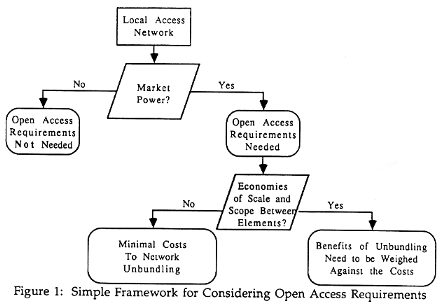
An analytical framework which might be useful for considering these questions is shown in Figure 1. Given the local exchange network and local transport markets it serves, open access requirements should be considered if the LEC holds substantial marke t power to hinder the development of competition. If this is not the case, then the market should support some degree of competition and no open access requirements are needed. For the case where open access requirements are necessary, the next issue is t o decide the extent to which unbundling is needed to open access to the network. When there are strong economies of scale and scope between the unbundled network elements, the process of network unbundling will make these economies unrealizable and therefore impose costs. To ensure that such a policy would be cost-effective, the benefits of the unbundled network components should be weighed against the lost economies arising from the unbundling process. Finally, if there are no large economies of s cale and scope between the unbundled elements, then the costs of the unbundling process are less of a policy concern (although the actual costs of unbundling still need to be considered).
A full analysis of the questions raised in the broad framework of Figure 1 falls beyond the scope of this short paper, which seeks to investigate only a small subset of the issues associated with network unbundling. This framework does highlight, howev er, the difficult issues which should be carefully considered if network unbundling is to be applied broadly as a policy tool to open network access for the purposes of promoting competition:
The focus of this paper is confined to the first issue listed above. Focusing upon this question, however, offers useful insight into the other issues by describing the technical context through which the process of network evolution and unbundling mig ht have to proceed. To investigate this issue, the paper examines in a qualitative manner how a local exchange network could be unbundled in light of recent technological developments. The methodology taken in this paper is to investigate the prospects fo r unbundling network architectures which have been proposed by the LECs. This includes exploring how network elements might be separated using new technologies such as fiber optic transmission systems, digital switches, or intelligent network platforms. B y selecting outcomes for analysis which might "naturally" occur through the process of network evolution, the paper implicitly identifies network components that could be unbundled at relatively low cost according to the LECs' strategy of network evolution. 6
The resulting set of unbundled network components is important because it defines the set of options available to independent service providers. They have the option to offer any one of the unbundled components using their own resources. Thus, the exte nt to which a future network architecture provides a set of low-cost unbundled service elements also defines the flexibility afforded to independent service provider in building their own customized services.
This paper will show that it is likely that network unbundling requirements can be expected to impose costs by influencing how the LECs will build their networks. The upshot of this finding is to place added importance upon developing a framework for w eighing these costs against the benefits of the open access requirements as the LECs incorporate new technologies into their network. Such a framework would be a useful, if not indispensable, policy tool for insuring that network unbundling does not impos e undue costs by unbundling network elements from which telecommunications consumers derive little benefit.
To begin the analysis, the first section examines how physical unbundling might occur as digital optical transmission systems are introduced throughout the public network. Section II examines how logical unbundling might be possible using the advanced intelligent network (AIN) platform model as a guide. The final section synthesizes the results of these discussions and presents some general principles and consequences of unbundling physical and logical network components in this technological environme nt of the future. 7
II. Physical Unbundling
This section examines the prospects for physically unbundling the network transmission and switching technologies which appear likely to be incorporated into the local access network architecture over the next two decades. With regard to transmission t echnology, the paper focuses upon the increasing use of fiber optic cable in the subscriber loop. With regard to switching and multiplexing, the paper investigates the trend to a digital cell-based technique known as asynchronous transfer mode.
Before proceeding further, however, it would be useful to better clarify how network unbundling might occur with physical components. Unbundling network elements creates the opportunity for service providers to offer a service using a combination of LE C provided and private network components. Thus, one choice of an independent service provider is to provide any network component using its own private resources. If the service provider selects the LEC's unbundled component, it might be presented with t wo options. First, it could use the LEC elements to form a dedicated network to deliver a service independent of any other services on the public network service platform. In this case a service might be delivered partially, or entirely, to the customer o ver unbundled physical elements purchased from the public network operator for the exclusive use of the service provider. Second, unbundled physical components could be used to deliver a service which is integrated with other network services (although pe rhaps on a "virtual" basis). For example, the service provider might interconnect to the public network to receive dial tone by purchasing unbundled physical elements. Either application for unbundled physical elements may be considered depending upon the particular situation.
Unbundling Network Transport Using Fiber Optic Networks
A transmission link exists to transport information from one location to another in recognizable form. Three key functional attributes of this link are its capacity, location and quality of service. If network unbundling is a beneficial process, then i t should somehow enhance one or all of these attributes of the transmission networks. That is, unbundling a transport network would presumably improve at least one of the following criteria: a) access to network capacity; or b) access to intermediate inte rconnection points along the transmission path. 8 The methodology taken in this paper is to use these two criteria to qualitatively evaluate the prospects for unbundling physical transmission elements of the existing copper and proposed fiber-based network architectures. If an unbundled network improves one or both of these criteria, then one outcome of this process would be to lower the cost of transmission by either allowing more efficient access to net work capacity or the independent provision of some transport segments.
The current copper-based network presents limited opportunities for unbundling the transmission components using these two criteria as a metric of evaluation. First, for the transmission distances associated with the subscriber loop, the amount of band width available over twisted wire pair is limited roughly to the DS1 rate of 1.5 Mbps. Thus, in a future where broadband services will become increasingly important, the copper network is severely constrained in the broadband services it can carry, and in the excess capacity available for use on an unbundled basis (unless there are spare pairs available). Second, the current switched-star architecture runs at least one dedicated twisted pair from a central switching node all the way to each customer witho ut any intermediate locations available to unbundle the transport segment. Beyond the central office, there are generally no nodes which provide an opportunity for interconnection which would unbundle transmission segments in the subscriber loop. For thes e reasons, the current network does not appear well suited for physical unbundling.
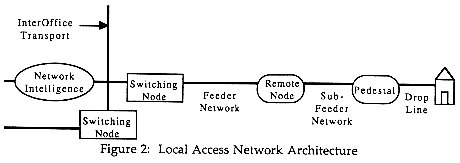
While the current network may not be an attractive prospect for unbundling physical transmission components, fiber networks would appear to offer more opportunities. Figure 2 shows the local access network architecture that could be used by telephone c ompanies to deploy fiber in the future. The figure indicates the customary central office switching node in addition to nodes at a remote site and the curb-side pedestal. These network nodes serve as network flexibility points where, depending upon the architecture, signals can be switched or multiplexed to the appropriate destination. The switched-star network architecture, which serves the great majority of telephone lines in the U.S., only includes one network flexibility point at the central of fice switching node. A small percentage of lines (less than 7% in 1989 according to (Vanston, Lenz, et al., 1989)) are served by digital loop carrier (DLC) systems which incorporate a second flexibility point into the architecture at the remote node. The third flexibility point at the pedestal has been proposed for fiber-to-the-curb systems in the future. The architecture of Figure 2 also includes a central node for network intelligence, where the functionalities of the proposed advanced intelligent netwo rk are to be located.
How do fiber networks rate using the unbundling criteria? With regard to the first criterion, the fiber cable itself will effective impose no constraint in the amount of bandwidth available for unbundling. Indeed, LECs want to install fiber because of the enormous increase in bandwidth and the lower transmission losses it offers in comparison to metallic transmission lines. One fiber can transmit information at a data rate several orders of magnitude higher than what a copper wire pair can carry. 9 The bandwidth limitations of a fiber system are not due to the intrinsic properties of the fiber, but the limitations of the switching, multiplexing, and transmission equipment connected to the fiber.
In sum, because of the tremendous bandwidth potential of fiber optic cable, there is virtually unlimited bandwidth available for unbundling purposes. This simple observation must be accompanied with two important caveats. First, the abundant bandwidth that is theoretically available for unbundling on a fiber cable is not likely to be accessible for some time until the capabilities of the network equipment improve enough to utilize it. Second, this bandwidth is only available over the fiber links of a n etwork. Because the adoption of a new technology is likely to be a gradual process, fiber will first be deployed in hybrid network architectures which continue to utilize existing portions of the copper network. As a result, until fiber is deployed all th e way to the customer premises, portions of the network will continue to present the same limitations to physical unbundling as the current network.
While fiber systems may not present any intrinsic limitations to unbundling system bandwidth, the other important unbundling criterion against which they must be measured is the degree to which different transmission segments of the fiber network can b e unbundled. To answer this question requires an understanding of the transmission elements of the local access network architecture, and the strategy of network evolution for incorporating fiber into the network.
The anticipated trend in the transmission technology of the telephone network is the deployment of fiber progressively closer to the customer premises (Reed, 1991). Fiber was first used in long distance and interoffice portions of the telephone network where the large volume of traffic justified the additional cost and bandwidth of fiber links. 10 As the costs of optical systems have fallen, fiber may now be deployed in the feeder portion for DLC sys tems when the length of the feeder network is long enough to justify the higher costs of fiber, or the additional flexibility of a digital optical system is desired to accommodate the needs of more sophisticated business users. As the cost of fiber equipm ent declines further and more services are added to the network platform, the economics of deploying fiber will favor extending fiber closer to the end user.
The point at which the fiber portion of the network ends and the optical signal is converted to an electrical signal is called the optical network interface (ONI). As noted above, because the costs of fiber systems are declining, the location of the ON I has been gradually sliding closer to the end user as optical transmission technologies mature. Where the ONI is located at any particular time in the transition to a fiber network will depend upon the network architecture of the telephone network. For t he vast majority of lines, the ONI is currently located at the switching node; for those lines served by optical DLC systems, it is located at the remote node. Future systems deploying a fiber-to-the-curb architecture would place the ONI at the pedestal, while a fiber-to-the-home architecture moves the ONI all the way to the end user's premises.
The significance of the ONI with regard to the unbundling of network components is that it represents a natural flexibility point--or low-cost interface point--for the system where the local access transport segment can be broken into unbundled element s. As will be illustrated below, as the ONI moves progressively closer to the end user, the network platform will evolve to different network architectures, and new, or lost, opportunities for network unbundling. The current copper network, with its ONI e ssentially located at the switching node, was not an attractive architecture for unbundling network transport. This situation will change as fiber penetrates into the network through the gradual progress of network evolution.
Figure 3 illustrates three examples of how the location of the ONI can influence the extent to which portions of the local access transport can be unbundled at minimal cost. The first case considered in Figure 3(a) could be regarded as a near-term netw ork architecture using an optical DLC system without an intelligent network service platform. The figure illustrates the possible network interfaces that could be available to unbundle local access transport. For example, transport could be unbundled usin g this architecture between interfaces B and C for interoffice transport, interfaces D and E for feeder transport, and F and I for transport in the distribution network. Thus, unbundling the local access portion of this architecture could result in two tr ansport elements: a fiber-based feeder portion and a copper-based distribution portion of the network.
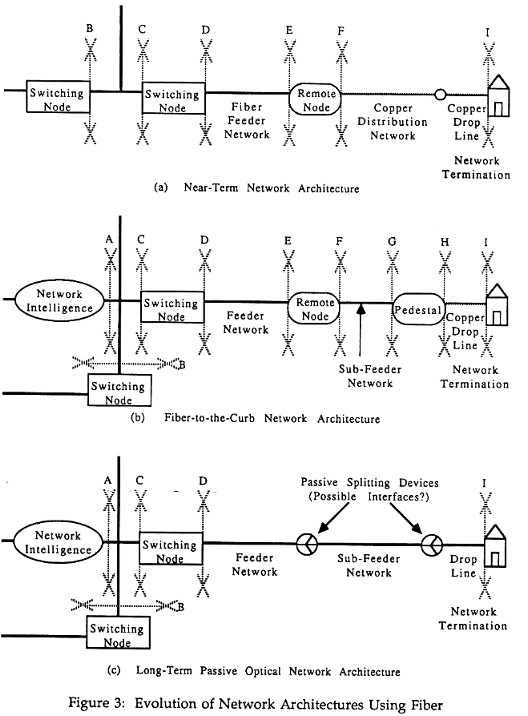
Figure 3(b) illustrates a more futuristic network architecture with a fiber-to-the-curb system and an intelligent network platform. 11 The fiber-to-the-curb system places another flexibility point in to the network architecture which provides another level of unbundling local access transport. Under this architecture, transport could be unbundled between interfaces A and B for transport of network signalling, between B and C for interoffice transport, between D and E for feeder transport, between F and G for sub-feeder transport, and between H and I for the drop. As will be apparent with the next step in network evolution, this architecture may be the high-water mark for unbundling transport because o f all the flexibility points in the architecture.
With the gradual deployment of fiber toward the end user, there is an accompanying trend to passive optical networks (PONs) which use some of the unique transport properties of optical signals. A PON places only passive components at the network flexib ility points. Instead of electronic multiplexing and switching electronics at a flexibility point, a PON deploys optical couplers and splitters which take advantage of optical properties of the transmission signal to rout signals without the need for elec tronic equipment. PON architectures have fibers that fan out from the switching node via passive optical splitters similar to a tree and branch topology. In this way, PON networks can reduce costs by achieving a high degree of shared plant throughout the network. The lowest branch in the distribution tree connects to the individual homes.
Figure 3(c) is an example of a PON architecture where the remote node and pedestal flexibility points consist of passive optical components. As can be seen in the figure, if the passive nodes cannot offer access or interconnection services, then there are no low-cost interfaces in the local access portion of a PON. Passive nodes could provide interfaces like those described in Figure 3(b) if it is possible to inject or receive an optical signal using the passive components. In a PON system, the optical power budget determines the number of successive splitting nodes in the network. Larger bandwidth signals have smaller power budgets, so broadband services cannot be split as often as narrowband services. Thus, where a signal can be injected or removed f rom the network will depend upon the power budget as dictated by the PON architecture. 12
The important point is that a different set of requirements arises when attempting to access a fully optical network as opposed to the current metallic or proposed hybrid networks. The bandwidth limitations of the metallic transmission media no longer exist, but they are replaced by concerns for the power budget and costs imposed by the network design. The margin of the power budget is set by the characteristics of the optoelectronics and the network topology. Expected advances in optoelectronics will increase the power budget, thus improving the flexibility of the network to accommodate unbundling of network capacity, and lower costs. Note, however, that one of the principal benefits of the PON approach is to eliminate "active" nodes in the network to avoid the high costs of providing power to these locations. Receiving or injecting an optical signal would require electronic equipment with power needs that might not be otherwise supported by the network operator.
Finally, with the continuing rapid advance in optical transmission technologies, an unresolved issue of great interest is the fiber-based network architecture most suited for the subscriber loop. While the strategy of network evolution presented above is consistent with many forecasts, there have been a number of alternative approaches proposed for installing fiber in the subscriber loop that vary depending upon the services carried by the network. The results of this section clearly demonstrate how th e opportunities, and costs, for network unbundling can vary with network architectures. Thus, one would clearly expect both new and lost opportunities for low-cost network unbundling with each proposal.
Unbundling Digital Transfer Modes
The transfer modes of the network define the switching and multiplexing techniques that characterize the transmission structure of the system. The current network uses synchronous transfer mode (STM) techniques for switching and multiplexing digital si gnals. 13 Future networks will continue to assume a synchronous transmission hierarchy at the physical layer using the synchronous optical network (SONET) standards defined by the International Consulta tive Committee for Telephone and Telegraph (CCITT) standards group. The SONET standard describes a family of broadband digital transport signals operating roughly at multiples of 50 Mbps. As a result, wherever SONET equipment is used, the standard interfa ces at the central office, remote nodes, or subscriber premises will be multiples of these rates.
Above the lower layers of the architecture, however, the network will probably not continue to be entirely synchronous, but will instead employ some asynchronous transfer mode (ATM) techniques. ATM uses packet switching and routing techniques to carry information signals, independent of their bandwidth, over one high speed switching fabric. For example, an information signal would be separated into fixed length cells, each consisting of a header for routing directions and an information field for data. These cells then combine with the cells of other signals for transmission to a common destination. In time division multiplexing (TDM) the position of the data channel in time is important, in ATM the label of the channel distinguishes it f rom another. The cells fit into the payload of the SONET frame structure for transmission. ATM promises to blur the distinction between switching and multiplexing on the cell level since an ATM switch is likely to integrate these two functionalities. Ther e will, however, continue to be SONET multiplexers that combine and separate SONET signals carrying ATM cells.
What distinguishes ATM from a synchronous approach is that subscribers have the ability to customize their use of the bandwidth without being constrained to the channel data rates of the network transmission scheme. This characteristic, often touted as "bandwidth on-demand," allows variable data rate services to be easily combined by simply inserting the ATM cells into the SONET payload. In contrast, combining variable data rates using TDM can be difficult due to the different timing requirements of ea ch signal.
For unbundling, the most important component of the transfer mode is the switching element (the multiplexing elements being unbundled by their very nature). An important trend in the current switching system is the move of network intelligence out of t he switching software onto an intelligent network platform (see Section III for more on the logical functions of the intelligent network). Consequently, once the intelligent network is implemented, many of the logical network components will be separated from the physical switching element--where the physical component of a current digital switch consists of 64 Kbps (DS0) access to the network switch.
ATM techniques could improve the prospects for unbundling the physical switching elements of the network. The attribute of the ATM switch which could facilitate more modularity is the bandwidth flexibility it affords. Because each information signal is decomposed into cells, switching is performed in much smaller increments. Today, a digital switching element provides the capacity to switch a DS0 signal whether or not the user has the need for this much bandwidth. With ATM, the switching element resour ces can be much more efficiently matched to the bandwidth requirements of the user. By reducing the unit of access to switching resources, ATM can make more convenient increments of switching elements available on an unbundled basis. Access to the ATM swi tch will be specified according to the maximum data rate forecasted for the particular access arrangement, instead of specifying the number of DS0 circuits required as is the case today with digital switches.
III. Logical Unbundling
In addition to the physical components discussed above, logical network features might also be included in the network unbundling process. For example, one of the questions raised by the Notice of Inquiry initiated by the FCC into future architectures of the intelligent network is the extent to which a network switch could be programmed by an independent service provider as part of its service application software. In the same way that the personal computer has served as a platform to spawn a new indus try of application software developers offering computer services, could the public network play a similar role as the public platform that stimulates a new application software industry for innovative network-based services? An essential characteristic o f the public network platform, if it is indeed capable of assuming such a role, will be the extent to which the logical elements of network functionalities can be offered on an unbundled basis.
This section investigates what opportunities may be available for unbundling the logical elements of the network in light of the new technologies being developed for the operating system of the telephone network. Like the success of the applications so ftware market for personal computers, the future success of service providers on an open network platform is certain to hinge upon the distinctive features incorporated into their own service software. In a competitive environment, service providers will place a high premium on being able to customize their services using unbundled logical elements combined with their own proprietary software functionalities.
Presumably there will be the most demand for those logical features which can most efficiently be offered by a centralized network resource. Otherwise, the logical function could be implemented through private software on a decentralized basis. Finding which logical features can indeed be offered best through a public network platform again requires an analysis of the costs of unbundling versus the benefits of the unbundled network, which is beyond the scope of the current discussion. As was the case w hen examining the physical unbundling of network components, the approach taken in this section is to look at the proposed direction of network evolution, and examine how this network architecture might offer inherently low-cost unbundling of logical comp onents. Accordingly, the discussion begins with the capabilities of the advanced intelligent network (AIN), which the LECs are proposing to implement within the next decade.
The Advanced Intelligent Network
The LECs have been developing the AIN to provide themselves with the capability to rapidly create new services or customize current services. Today's switching system software contains most of the intelligence found in the network. The design of this s oftware is such that the applications software for any particular functionality is fully enmeshed into the systems software. Consequently, whenever a new feature or any other software modification is necessary, the entire switching system software must be tested by the switch manufacturer. Eventually, the repeated addition of features and modifications can degrade the original switch architecture to the point where it becomes increasingly difficult to respond in a timely manner to the dynamic needs of the customers.
The limitations of this architecture became particularly apparent when intelligent services were deployed with functional elements that require a centralized network architecture. For example, the first network-wide intelligent service available over t he public network was the 800 number service (Sable and Kettler, 1991). The network intelligence for this service resided in the switching software of the toll exchanges. Yet as the need increased for more intelligence in the service, maintaining the inte lligence in a distributed architecture (i.e., in every toll exchange) became increasingly difficult and impractical. The LECs now want to develop a network architecture which enables more efficient and rapid network management on a centralized basis for t he creation, provision, and deployment of services like 800 number service.
The AIN attempts to satisfy these criteria by defining a network architecture where the logical features are distributed from the switching nodes to intelligent network nodes (see Figure 2). By moving this intelligence away from the switching node, a L EC is able to concentrate logical functions at more centralized intelligence nodes instead of the more numerous local exchanges--assuming such a concentration is desirable from a cost standpoint (Wyatt, Barshefsky, et al., 1991). For example, a new sequen ce of logical instructions, called the service logic, could be installed at the intelligent node without requiring software upgrades in all the switching systems. The degree of centralization that might be desirable for any particular service will vary, depending on service characteristics and the type of network.
The important characteristic of AIN is that it offers the flexibility to configure the network according to the characteristics of the service. The modular architecture is capable of adding adjunct processors, such as voice processing equipment, data c ommunication gateways, and alternative switching systems, to the platform, without modifying the application interfaces (Lemay, Chorley, et al., 1990; Wyatt, Barshefsky, et al., 1991). These adjuncts, which provide service logic and local customer data, h ave capabilities similar to centralized intelligence nodes but are situated at the local level (i.e., at the local exchanges). They are an attractive option for particular applications requiring local, transaction-intensive services as opposed to network routing services, which can be more efficiently supported at the central intelligence nodes. The functionalities of the adjuncts, however, are limited by the capabilities of the application interface to the switch.
At a more fundamental level, the difference between today's network architecture and one with the network intelligence unbundled from the switch lies in how the switching node processes each network connection request. When a call is placed on the curr ent network, the switch executes the service logic according to the call model embedded in the switching software. The call model defines what steps, or check points, are executed during the call. AIN specifies a new call processing model with a new set o f steps, or check points which depend upon external processors to operate. When a call is placed, the switch executes the call model and, depending upon the instructions, launches queries to the external processors of the intelligent network. Designing th e call model in this way separates--or unbundles--the switching functions from the application functions residing in the intelligent nodes.
The basic architecture of the AIN takes these application functions and breaks them into a collection of function specific components that interact using a standard communication protocol (Arnold and Brown, 1990). The sequence of these unbundled logica l elements, and the specific parameters within each logical element, distinguish one application from another. 14 Notably, the crucial technology necessary to implement this architecture is the operatin g system software which can support network services in this environment of unbundled logical components. 15 Ultimately, the objective of the AIN is to allow modifications to application software withou t having to alter the operating system of the switch. If any service provider is capable of developing application software to operate over the network, it is imperative that this software will function on top of the operating system of the switch without any modification. The ability for the network platform to accommodate new applications in this fashion is therefore an essential requirement of an open architecture featuring unbundled logical elements. The tool in AIN that creates and introduces new ser vices in this manner is the service creation environment discussed below.
The Service Creation Environment
The objective of the service creation environment is to provide the necessary platform to create, debug, and test new services. Before it can be used, any new software (or service logic) must undergo extensive debugging and verification to reduce the p robability that it will harm the overall operation of the network. The service creation environment would test whether any of the new features of the service would interact with existing services to cause the system to crash. When a new feature is introdu ced, there are three feature interaction categories which must be managed to insure operability (Russo, Abdel-Moneim, et al., 1991): 1) interactions between the new locally based feature with other locally based features; 2) interactions of a local based feature with remotely based features (either in a adjunct or intelligence node); and 3) interactions of the remotely based new feature with other remotely based features.
The most interesting question, of course, is the extent to which independent service providers could use this tool to create and test new software applications of their own on the network service platform. The expense of service verification, along wit h associated security issues, could preclude extending this capability directly to service subscribers (Morgan, Cosky, et al., 1991). On the other hand, it may be possible to design the system software to protect itself from network reliability and securi ty threats while still offering open access to some logical elements. Resolution of this issue will require balancing the benefits of open logical access against the costs of an open, modular architecture. In a special issue of AT&T Technical Journ al on the intelligent network, AT&T seemed optimistic regarding the prospects for an open architecture when it states that services residing in the adjuncts and intelligent network nodes could be created "either by vendors, service providers, or e nhanced service providers" (Sable and Kettler, 1991, p.8).
One method to control network reliability and security is to design the operating system into logical layers. A layered architecture can isolate the service logic executing in a higher layer from lower layers and thus reduce the chances that it will af fect the operations of the lower levels. In a local exchange network, a layered software structure would attempt to isolate the switching system core, which includes basic call control functions, from the application features. The basic system functions n ecessary to most of the application features would therefore be consolidated in the lowest level. In fact, the AIN architecture can be described in three layers (Lemay, Chorley, et al., 1990; Morgan, Cosky, et al., 1991). If a design can be achieved which allows each layer to operate independently, with access to lower levels restricted according to access privileges, then the concerns for network reliability and security might be met. In one scenario, for example, the switch manufacturer could supply the platform software for the bottom layer, while the service providers design and operate service scripts on the top two layers.
In summary, this description of the AIN architecture portrays the possibilities that the future may hold for unbundling logical elements. As customers of the switch vendors, the LECs are seeking the means to unbundle all the functionalities of the serv ice platform from the switch to obtain the flexibility they desire to create new services. For policy makers, the important question is whether the same flexibility afforded to the LECs through the logically unbundled AIN could be extended to independent service providers to open access to the network. The extent to which logical elements could be unbundled remains the subject of debate. The fundamental trade-off in this debate weighs the benefits of the modular logical architecture against the costs of u nbundling and assuring network reliability and security.
IV. Future Prospects for Unbundling Logical and Physical Elements
The FCC is now considering how more competition can be brought to the local access switching and transport markets while still preserving other regulatory objectives. The FCC has already begun to impose open access requirements through a series of dock ets on ONA, and is considering further actions in its recent Notice of Inquiry on Intelligent Networks and Expanded Interconnection. The cornerstone of these policies is the notion of unbundling network components to open access to network resource s. This paper has presented a simple qualitative framework for considering the circumstances under which open access requirements might be considered, and the appropriate conditions for implementing network unbundling to achieve an open network architectu re in light of new technological developments.
In general, the analysis showed that network unbundling of both physical and logical elements of new technologies can be expected to impose costs by influencing how the LECs will build their networks. With regard to unbundling the physical network elem ents of future network technologies, the paper concludes:
With regard to unbundling the logical network elements of future network technologies, the paper concludes:
The threat to network reliability and security posed by open architectures is a complex technical issue. An open architecture increases the risks of intrusions, system failures, and potential privacy breaches by those predisposed to electronic vandalis m. In addition, the operation of thousands of service applications on the network platform increases the chances of a system failure caused by incompatible software instructions. Because the network is a shared resource, the troubles of one application ca n send shock waves throughout the entire network. Nevertheless, whether in response to regulation or competition, at some point in time it seems likely that a new level of openness will have to be incorporated into the network, forcing new developments in software technology to reflect the reality of the changing marketplace.
The concern for network security should not, however, preclude the possibility of an open architecture. Advances in software technology are likely to offer opportunities for building an open network while still protecting its integrity. For example, on e could imagine designing a network platform with a layered operating system requiring successively more verification to enter a lower level of the system. By designing the platform so that applications are not integrated with operating system, concerns f or network security and reliability could be addressed. The key point is that these concerns can be addressed on a technical level, but at some cost. Whether this cost would exceed the benefits of logical unbundling is the larger question which regulators must consider.
The implications of these developments to regulators suggest that a framework is needed for weighing such costs against the benefits of the open access requirements. If the costs of an open architecture are high, then an open architecture might only be economically viable if the LECs hold substantial market power. But if a number of competing transport suppliers, such as cable television operators, PCS suppliers, or alternative local access suppliers, emerge to compete for a share of this market, the m onopoly power of the telephone companies will erode. Indeed, the additional costs of unbundling could actually hinder the LECs ability to compete effectively in the market. A competitive transport market could develop into a market analogous to computers where customers actively seek the lowest cost suppliers because there is no significant differentiation in the underlying functionality of the hardware. 16
This paper has only delved into the rudimentary elements of the new technologies which could be implemented in future LEC networks. A more comprehensive review of the economics of unbundling and the associated policy issues remains to be completed. Nev ertheless, this study does indicate the need for a analytical framework to consider how network unbundling should occur as new technologies are introduced into the network. Policies concerning open network access can directly affect the design of the netw ork, as well as the long term strategies of network evolution for both LECs and independent service providers. These great stakes place an added weight upon policy deliberations. Any policy decisions made now can materially affect, for example, the design of the advanced intelligent network platform and how it will be deployed over the next decade. When a strategy of unbundling network elements is pursued, policy makers will necessarily be operating along a fine line regarding how much responsibility will be retained by the LECs to design and implement their own strategies of network evolution.
V. References
Arnold, E.C., and D. W. Brown. Object Oriented Switching System Architectures and Software Development Processes. Proceedings of the National Communications Forum. Rosemont, Illinois: 1990. 44: 795-802.
Lemay, John et al. Prototyping Environment for New Service Creation. Proceedings of the National Communications Forum. Rosemont, Illinois: 1990. 44: 544-550.
Morgan, Michael J. et al. "Service Creation Technologies for the Intelligent Network." AT&T Technical Journal 70.3-4 1991): 58-71.
Reed, David P. Residential Fiber Optic Networks: An Engineering and Economic Analysis. Boston: Artech House, 1991.
Russo, Ernest G. et al. "Intelligent Network Platforms in the U.S." AT&T Technical Journal 70.3-4 1991): 26-43.
Sable, Edward G., and Herbert W. Kettler. "Intelligent Network Directions." AT&T Technical Journal 70.3-4 1991): 2-10.
Vanston, Lawrence K. et al. "How Fast is New Technology Coming?" Telephony September 18, 1989.
Wyatt, George Y. et al. "The Evolution of Global Intelligent Network Architecture." AT&T Technical Journal 70.3-4 1991): 11-25.
Note 1: The views expressed in this paper are solely those of the author and do not necessarily reflect those of the Federal Communications Commission, the Commissioners, or any of its staff. The author would like to thank Ev an Kwerel, Kathie Levitz, and Robert Pepper for their helpful comments. Back.
Note 2: For the most recent FCC action regarding ONA, see Memorandum Opinion and Order, Filing and Review of Open Network Architecture Plans, CC-Docket No. 88-2; FCC 91-382 38309, Released December 19, 1991. Back.
Note 3: An equally important role of ONA is to establish the tariff guidelines for the unbundled offerings to insure that access to the network is nondiscriminatory. Back.
Note 4: The notion of classifying elements into physical and logical categories is not original to this paper. For example, Bellcore has described a future network architecture consisting of service and delivery segments, whi ch correspond to the logical and physical elements described above. The goal of the Bellcore architecture is to offer the functionalities of the service segments independent of the capabilities or functions of the delivery segment. This technology indepen dence could offer service providers more flexibility in using the network platform. See Information Networking Architecture (INA) Framework Overview. Bellcore Framework Technical Advisory FA-INS-001134, Issue 1, (August, 1990). Back .
Note 5: See Notice of Inquiry, In the Matter of Intelligent Networks, CC Docket 91-346, FCC 91-383 38274, December 6, 1991. For another FCC policy initiative with implications for network access, see Notice of Proposed Rulema king and Notice of Inquiry, In the Matter of Expanded Interconnection with Local Telephone Company Facilities, CC Docket 91-141, FCC 91-159 3259, June 6, 1991. Back.
Note 6: The consequence of this assumption is that the analysis will not uncover any unbundled network components that do not arise logically from the proposed architecture. Of course, a LEC has an incentive to modify its net work architecture to unbundle a particular component if sufficient demand existed to warrant its inclusion in the set of unbundled elements. Back.
Note 7: The scope of this paper is limited to examining the unbundling of the subscriber loop components of the public telephone network. The discussion does not focus directly upon the impact of unbundling the components of urban networks such as the fiber-based metropolitan area networks (MANs) that are currently proliferating. Back.
Note 8: The third possibility, not listed, is that unbundling the network could give service providers more flexibility in specifying the reliability or grade of service of the transmission path. This capability depends more upon the network operating system and transport protocols (i.e. logical features) then the physical transmission links, and therefore is not discussed in this section. Back.
Note 9: While comparing fiber and copper cable in relation to the total data rate they can carry demonstrates the large differential in bandwidth capability between the two, a more accurate description of the capacity of fibe r in the future is likely to be the number of wavelengths that can be transmitted over a single fiber. Instead of increasing the data rate of the transmission link as demand warrants, the capacity of a fiber link could be expanded by additional new wavele ngths. Back.
Note 10: One study estimated that in 1989, 84 percent of interoffice voice circuits in use were digital, with 41 percent of the circuits being carried by fiber links. The same study forecasted that the interoffice network wi ll be essentially all digital by 1995, and all fiber by 1999. See (Vanston, 1989). Back.
Note 11: This architecture is similar to what has been proposed by Bellcore as a the next step for using fiber in the local access network. See Bellcore Technical Advisory. Generic Requirements and Objectives for Fiber in the Loop Systems. Bellcore, TA-NWT-000909, (December, 1990). Back.
Note 12: Of course the power budget could be adjusted (increased) at a cost. However, such a cost could be very high in the PON architecture if it required a new optoelectronics in every household ONI device. Back.
Note 13: Transmitting information in digital form requires a timing reference to control the transmission. Without a clock synchronizing the entire digital network, the system would not be able to determine when to sample a signal to receive the transmitted information. Back.
Note 14: Bellcore offers one example that demonstrates how different services can be built by linking basic features in different orders. A 800 service with interactive dialing requires 4 features, which in sequential order are: number translation, play announcement, collect digits, and route call. A 976 number with screening (using a personal identification number) also requires 4 features: play announcement, collect digits, then either route call or play announcement. Exam ple taken from a presentation to the FCC by Elizabeth Ireland, "Advanced Intelligent Network: An Overview," September 19, 1991. Back.
Note 15: The programming language used to connect each building block is likely to be a object-oriented language which treats the system as a network of interconnected functional components or objects. In contrast, the tradi tional software approach has been to represent the system as a giant matrix of interacting functional activities. Back.
Note 16: Some argue that the reason that PCs have become commodities is that Intel Corp. and Microsoft Inc. effectively have monopolies for microprocessors and operating system software and sell their technologies to practic ally all comers. As a result, there is little differentiation in the functionality of the computer hardware beyond the intrinsic speed of the devices. See The Wall Street Journal, Thursday, September 5, 1991. p A1. Back.